
📋 Table of Contents
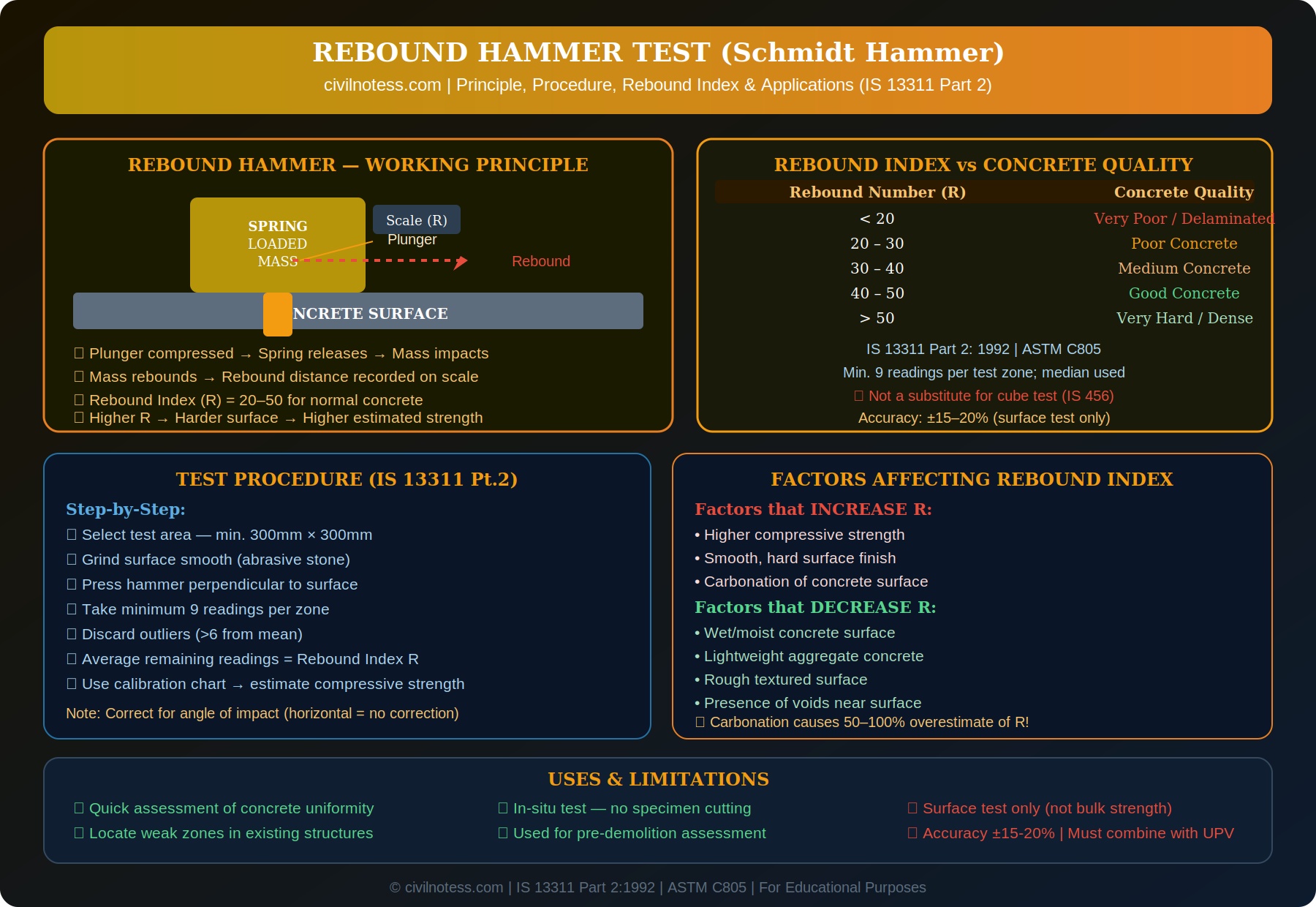
🔷 What is the Rebound Hammer Test?
The Rebound Hammer Test (also called the Schmidt Hammer Test, after Swiss engineer Ernst Schmidt who invented it in 1948) is a non-destructive test (NDT) used to assess the surface hardness and estimate the compressive strength of in-situ concrete. It is governed by IS 13311 Part 2:1992 in India and ASTM C805 internationally.
The test is widely used as a rapid, inexpensive, field test for:
- Uniformity assessment of concrete in a structure
- Identifying weak or suspect zones in existing structures
- Correlating rebound number to estimated compressive strength
⚙️ Working Principle
The rebound hammer works on the principle of elastic rebound of a spring-loaded mass:
- A spring-loaded mass (hammer) is released against a plunger pressed on the concrete surface.
- On impact, the mass rebounds. The rebound distance is recorded on a scale as the Rebound Number (R), ranging from 0 to 100.
- A harder concrete surface causes greater rebound of the mass → higher Rebound Number.
- The Rebound Number is correlated to compressive strength using a calibration chart (provided by the manufacturer and verified against core tests).
The rebound measures only the surface hardness — it does not penetrate into the concrete bulk and cannot detect internal voids, cracks, or honeycombing below the surface.
🔬 Test Procedure (IS 13311 Part 2:1992)
- Surface preparation: Select a test area of minimum 300mm × 300mm. Grind rough or laitance-covered surfaces with a carborundum stone to expose the aggregate.
- Surface condition: The surface should be dry. Wet or recently wetted surfaces give lower readings and must be avoided (or readings corrected).
- Hammer positioning: Hold hammer perpendicular to the test surface (horizontal direction). For inclined or overhead testing, angle corrections must be applied.
- Impact: Press plunger against surface, allow hammer to trigger and record rebound number from the scale.
- Number of readings: Take minimum 9 readings per test area, spaced at least 25mm apart to avoid testing over the same spot twice.
- Outlier rejection: Discard any reading that differs from the median by more than 6 units.
- Average: Calculate the mean of remaining valid readings = Rebound Index (R).
- Strength estimation: Use manufacturer’s calibration chart (angle-corrected) to estimate compressive strength from R.
📊 Rebound Number vs Concrete Quality
| Rebound Number (R) | Concrete Quality | Approx. Strength |
|---|---|---|
| < 20 | Very Poor / Delaminated concrete | < 10 MPa |
| 20 – 30 | Poor concrete | 10 – 20 MPa |
| 30 – 40 | Medium / Fair concrete | 20 – 35 MPa |
| 40 – 50 | Good concrete | 35 – 50 MPa |
| > 50 | Very hard / dense concrete | > 50 MPa |
Note: These strength values are approximate and depend heavily on the calibration of the specific hammer and the concrete mix being tested. Correlation with core tests from the same structure is essential for reliable results.
⚠️ Factors Affecting the Rebound Number
| Factor | Effect on R |
|---|---|
| Compressive strength (higher) | ↑ Increases R |
| Surface carbonation | ↑↑ Greatly increases R (may overestimate strength by 50–100%) |
| Smooth/hard surface finish | ↑ Increases R |
| Moisture (wet surface) | ↓ Reduces R by 2–5 units |
| Lightweight aggregates | ↓ Reduces R |
| Rough texture / honeycombing near surface | ↓ Reduces R |
| Voids or cavities immediately beneath impact point | ↓ Reduces R significantly |
| Type of aggregate (hard granite vs limestone) | Affects R |
⚠️ Critical Warning: Carbonation Effect
Carbonation of concrete surface (reaction of CO₂ with Ca(OH)₂) creates a very hard, dense skin on older concrete surfaces. This skin has significantly higher hardness than the underlying concrete. A carbonated surface can give a Rebound Number 10–15 units higher than the non-carbonated interior, leading to a massive overestimation of concrete strength. On old structures, always check carbonation depth (phenolphthalein test) before interpreting rebound numbers.
📐 Correction for Angle of Impact
| Hammer Angle | Correction to R (for R = 30) | Correction to R (for R = 40) |
|---|---|---|
| Horizontal (0°) — Standard position | 0 (no correction) | 0 (no correction) |
| Downward at +90° (overhead) | -5.4 | -3.1 |
| Upward at -90° (floor from below) | +3.2 | +2.0 |
| Downward at +45° | -3.4 | -2.0 |
| Upward at -45° | +2.2 | +1.3 |
Corrections are provided in IS 13311 Part 2 and the hammer manufacturer’s manual. The horizontal position is standard — when testing in other orientations, apply corrections before reading the strength chart.
✅ Advantages & Limitations
| Advantages | Limitations |
|---|---|
| Quick and inexpensive | Tests only surface hardness — not bulk strength |
| Non-destructive — no damage to structure | Accuracy ±15–20% at best |
| Portable and easy to use | Sensitive to carbonation, moisture, surface finish |
| Good for uniformity mapping | Cannot detect internal voids or honeycombing |
| Useful for identifying weak zones | Must be calibrated against core tests for reliable results |
| Minimum 9 readings reduces scatter | Not accepted for IS 456 compliance testing |
❓ Exam FAQs — Rebound Hammer Test
Q1. What is the IS code for Rebound Hammer Test?
IS 13311 Part 2:1992 — Non-Destructive Testing of Concrete: Methods of Test, Part 2: Rebound Hammer. (Part 1 covers UPV test.)
Q2. How many readings are required per test zone in the Rebound Hammer Test?
Minimum 9 readings per test zone are required as per IS 13311 Part 2. Any reading differing from the median by more than 6 units must be discarded.
Q3. Why does carbonation increase the rebound number?
Carbonation converts Ca(OH)₂ at the concrete surface to CaCO₃ (calcium carbonate) which is harder and denser than uncarbonated concrete. This harder surface causes a greater rebound of the hammer mass, giving a falsely high rebound number that overestimates the concrete’s actual strength.
Q4. Can the Rebound Hammer Test replace cube testing for IS 456 compliance?
No. IS 456:2000 Clause 15 clearly specifies that the compressive strength test of concrete cubes (IS 516) is the standard acceptance test. The Rebound Hammer Test is only used as a supplementary tool for uniformity assessment and approximate in-situ strength estimation — it has no statutory acceptance role under IS 456.
📝 Quick Summary — Rebound Hammer Test
- NDT test for surface hardness of concrete (IS 13311 Pt.2)
- Principle: Spring-loaded mass rebounds off concrete — higher R = harder surface
- Min. 9 readings per zone | Median ±6 units rejection rule
- R < 20: Very poor | R 30–40: Medium | R > 40: Good | R > 50: Very hard
- Accuracy: ±15–20% only | Cannot detect internal defects
- Major pitfall: Carbonation gives falsely HIGH rebound number
- CANNOT replace IS 456 cube testing for compliance