
📋 Table of Contents
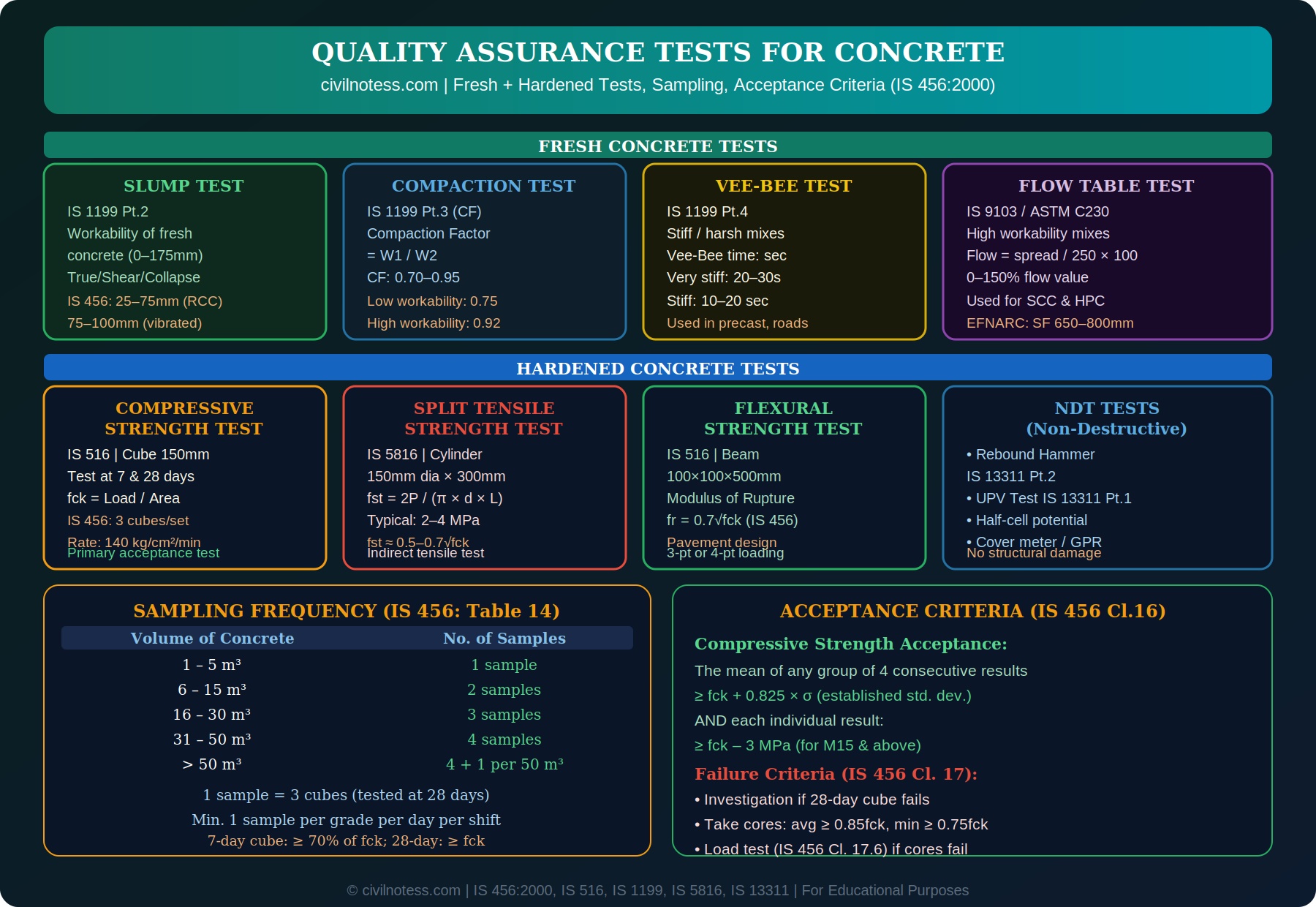
🔷 Quality Assurance in Concrete Construction
Quality Assurance (QA) in concrete refers to the systematic process of planning, controlling, and monitoring all activities to ensure that the concrete produced meets the specified requirements of strength, durability, and workability. Quality Assurance covers two phases:
- Fresh concrete tests: Conducted immediately after mixing — before placement — to verify workability and consistency of the mix.
- Hardened concrete tests: Conducted after the concrete has hardened — to verify achieved strength and durability.
The overarching standard in India is IS 456:2000 — Plain and Reinforced Concrete Code of Practice, Sections 14–17, which specify all QA requirements for concrete construction.
🧪 Fresh Concrete Tests
1. Slump Test (IS 1199 Part 2)
The most common workability test. A standard Abrams cone (top Ø 100mm, bottom Ø 200mm, height 300mm) is filled in 3 layers, each tamped 25 times. Cone lifted vertically → slump = difference in height:
- True slump: Concrete slumps evenly — acceptable for most work
- Shear slump: Half cone slides — indicates harsh/over-stiff mix
- Collapse slump: Complete collapse — too workable, possible excess water
- Slump values per IS 456: Sections/columns: 25–75mm | Slabs/beams: 50–100mm | Pumped concrete: 75–125mm
2. Compaction Factor Test (IS 1199 Part 3)
Measures workability of concrete with slump < 25mm (stiff mixes):
3. Vee-Bee Consistometer Test (IS 1199 Part 4)
For very stiff mixes (Vee-Bee time > 10 seconds). Measures time for concrete to remould under vibration:
- Vee-Bee time > 30 sec: Extremely dry/stiff (mass concrete, pavements)
- 10–30 sec: Very stiff (precast products)
- 5–10 sec: Stiff (lightly reinforced sections)
4. Flow Table Test (IS 9103 / ASTM C230)
Used for highly fluid or SCC mixes. Concrete placed in cone on a flow table, table dropped 25 times, flow measured as average diameter spread. Flow value = (spread / 250mm base) × 100. For SCC: Slump flow 650–800mm measured using this principle (IS 1199 Part 6).
🏗️ Hardened Concrete Tests
1. Compressive Strength — Cube Test (IS 516)
Primary acceptance test. See dedicated section below.
2. Split Tensile Strength (IS 5816)
Cylinder 150mm dia × 300mm long placed horizontally in UTM. Load applied along a diametral line. Tensile splitting failure occurs along loaded diameter:
Relationship with compressive strength: fst ≈ 0.5–0.7 × √fck (IS 456)
3. Flexural Strength / Modulus of Rupture (IS 516)
Beam specimen: 100×100×500mm or 150×150×700mm. Tested under third-point loading (4-point bending) or centre-point loading:
Used in design of road and airport pavements where flexural strength (not compressive) governs.
4. NDT Tests for Hardened Concrete
- Rebound Hammer Test (IS 13311 Pt.2) — Surface hardness and estimated strength
- UPV Test (IS 13311 Pt.1) — Internal quality and crack detection
- Core Cutting Test (IS 516 Pt.4) — Actual in-situ compressive strength
- Half-cell potential test (ASTM C876) — Probability of rebar corrosion
- Cover meter survey — Actual concrete cover over reinforcement
- Ground Penetrating Radar (GPR) — Rebar mapping, void detection
🔲 Cube Compressive Strength Test (IS 516)
The cube compressive strength test is the primary acceptance test for concrete in India as specified in IS 456:2000:
- Specimen: 150mm × 150mm × 150mm steel mould (IS 10086). For aggregate ≤ 20mm, 100mm cube may be used.
- Sampling: Taken at point of delivery (not from the truck drum directly). Sample from 3 positions during discharge.
- Filling: 3 layers, each rodded 35 times (150mm cube). Alternatively vibrated externally.
- Curing: Demould at 24±0.5 hours. Immerse in clean water at 27±2°C until testing.
- Testing age: 7 days and 28 days. 7-day result used for early assessment; 28-day is the acceptance criterion.
- Loading rate: 140 kg/cm²/min (uniform rate) in compression testing machine.
- Number of cubes: Minimum 3 cubes per sample (test at same age — average = test result).
📊 Sampling Frequency (IS 456:2000 Table 14)
| Volume of Concrete (m³) | Number of Samples Required |
|---|---|
| 1 – 5 m³ | 1 sample |
| 6 – 15 m³ | 2 samples |
| 16 – 30 m³ | 3 samples |
| 31 – 50 m³ | 4 samples |
| > 50 m³ | 4 samples + 1 additional per additional 50 m³ |
• Minimum 1 sample per grade of concrete per day per shift
• 1 sample = minimum 3 cube specimens (cast, cured, and tested together)
• 7-day result should be ≥ 70% of 28-day characteristic strength
✅ Acceptance Criteria (IS 456 Clause 16)
IS 456:2000 specifies two acceptance criteria that both must be satisfied:
| Concrete Grade | fck (MPa) | Min. Individual Result | Mean Criterion |
|---|---|---|---|
| M15 | 15 | ≥ 12 MPa | ≥ 15 + 0.825σ |
| M20 | 20 | ≥ 17 MPa | ≥ 20 + 0.825σ |
| M25 | 25 | ≥ 22 MPa | ≥ 25 + 0.825σ |
| M30 | 30 | ≥ 27 MPa | ≥ 30 + 0.825σ |
⚠️ Action When Cube Test Fails (IS 456 Cl.17)
If cube test results indicate non-compliance with IS 456 acceptance criteria:
- Step 1 — Investigate immediately: Check batching records, curing records, specimen preparation. Determine if the failure is due to poor concrete or poor specimen preparation/testing.
- Step 2 — Core tests (IS 456 Cl.17.4): Cut minimum 3 cores from the suspect structural element. Core acceptance: average ≥ 0.85fck AND no core < 0.75fck.
- Step 3 — Load test (IS 456 Cl.17.6): If cores also fail, carry out load test on the structure. Structure is satisfactory if deflection recovery after 24 hours ≥ 75% of maximum deflection recorded.
- Step 4 — Structural strengthening or demolition: If load test fails, structure must be strengthened (FRP wrapping, jacketing) or in extreme cases demolished and reconstructed.
❓ Exam FAQs — Quality Assurance Tests
Q1. What is the loading rate for cube testing as per IS 516?
The loading rate for compressive strength testing of concrete cubes is 140 kg/cm²/minute (approximately 14 N/mm²/min). A uniform, continuous loading rate must be maintained until failure.
Q2. How many cubes are cast per sample as per IS 456?
Minimum 3 cubes per sample. All 3 are tested at the same age (7 or 28 days). The average strength of the 3 cubes = one test result. If one cube differs from the average by more than 15%, discard it and average the remaining two.
Q3. What is the acceptance criterion for 7-day cube strength?
The 7-day cube strength is used as an early indicator only — it is not an official IS 456 acceptance criterion. As a general guide, 7-day strength should be ≥ 70% of the specified 28-day fck. If 7-day strength is below 65% of fck, there is cause for concern and the 28-day result must be closely monitored.
Q4. What is the difference between Quality Control (QC) and Quality Assurance (QA) in concrete?
Quality Control (QC) refers to the specific testing and inspection activities — cube tests, slump tests, sampling. Quality Assurance (QA) is the broader management system that plans, monitors, and verifies that QC activities are performed correctly and that the overall construction meets specifications. QA includes documentation, calibration, trained personnel, and audits — not just testing.
📝 Quick Summary — Quality Assurance Tests
- Fresh tests: Slump (IS 1199 Pt.2) | CF test (IS 1199 Pt.3) | Vee-Bee | Flow table
- Hardened tests: Cube (IS 516) | Split tensile (IS 5816) | Flexural (IS 516) | NDT
- fr = 0.7√fck (Modulus of Rupture, IS 456) | fst ≈ 0.5–0.7√fck
- Sampling: IS 456 Table 14 | Min 3 cubes per sample | 1 sample/day/grade minimum
- Acceptance (IS 456 Cl.16): Mean ≥ fck + 0.825σ AND each ≥ fck − 3 MPa
- Failure sequence: Cube fails → Core test → Load test → Strengthening/demolition