📋 Table of Contents
🔷 What is Jacketing?
Jacketing is a structural strengthening technique in which additional material is applied around an existing concrete structural element (column, beam, slab, pier) to increase its load-carrying capacity, ductility, or durability. It is one of the most common rehabilitation strategies for structures that are structurally deficient due to: design errors, corrosion damage, earthquake damage, change of use (increased loads), or inadequate original design.
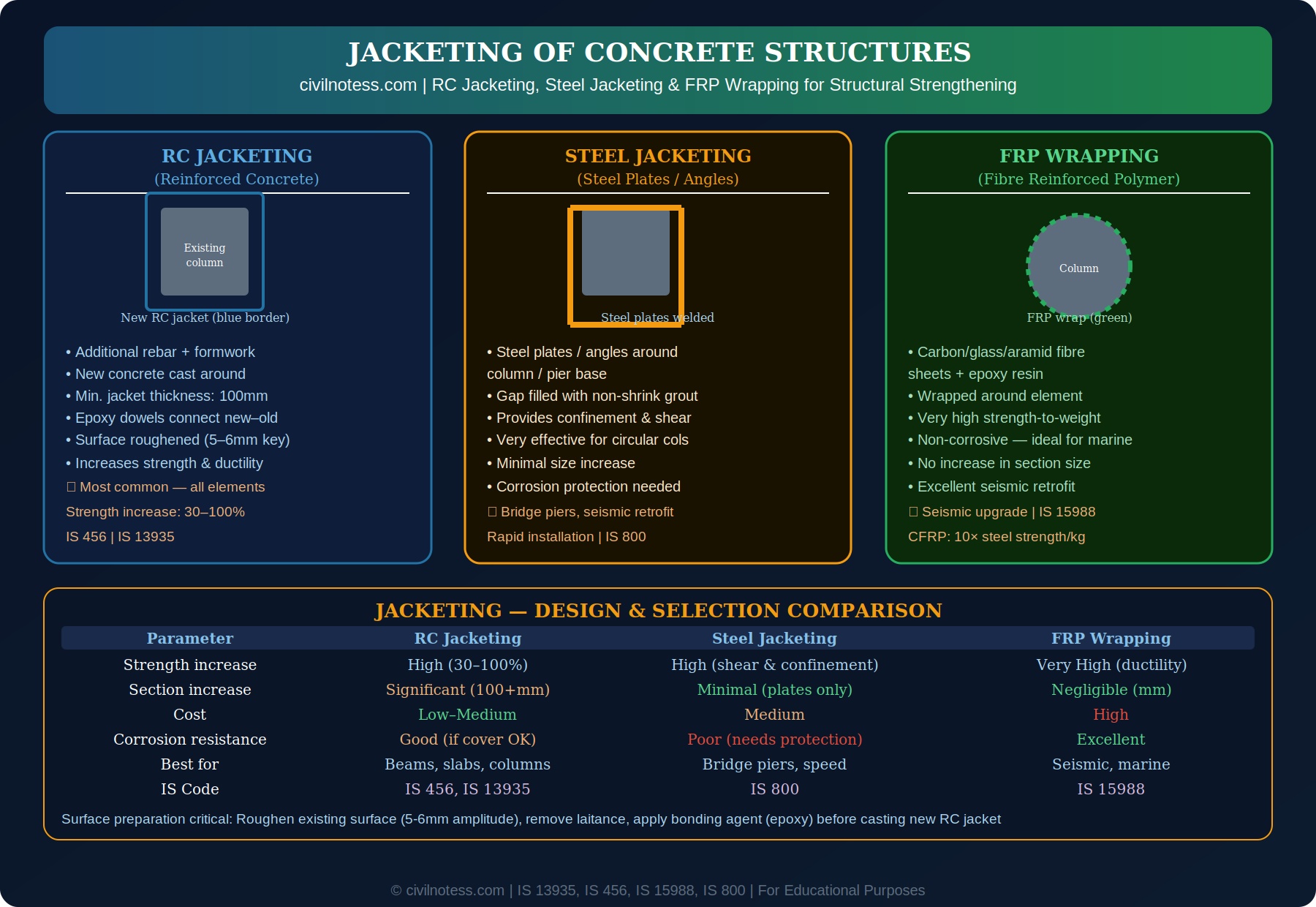
Three main jacketing systems are used: Reinforced Concrete (RC) Jacketing, Steel Jacketing, and Fibre Reinforced Polymer (FRP) Wrapping.
🏗️ RC Jacketing (Reinforced Concrete Jacketing)
The most widely used jacketing method. New reinforcement cage is placed around the existing column/beam, and fresh concrete is cast in formwork. The new concrete bonds to and composites with the existing element.
Design Requirements:
- Minimum jacket thickness: 100mm (to allow proper reinforcement cover and concrete placement)
- New longitudinal steel: Minimum 4 bars at corners | Lap spliced with existing bars through drilled holes if possible
- Stirrups/links: Closed links at max 150mm c/c for column confinement | 200mm for beams
- Connection to existing concrete: Epoxy anchor dowels drilled into existing column (IS 456) — minimum 150mm depth, 150–200mm spacing
- Concrete grade: New jacket concrete should be at least the same grade as existing, preferably one grade higher
Procedure:
- Roughen existing concrete surface to 5–6mm amplitude by mechanical means (bush hammering, sandblasting) — improves mechanical bond
- Drill and install epoxy anchor dowels (12–16mm dia, 150mm depth) at 150–200mm centres
- Apply bonding agent (epoxy primer) on existing surface immediately before casting
- Place new reinforcement cage — ensure minimum 25mm cover to new outer face
- Erect formwork — use self-compacting concrete or flowable mix to avoid honeycombing in confined jacket space
- Cast and properly vibrate/compact concrete
- Cure minimum 7 days
🔩 Steel Jacketing
Steel plates (typically 6–12mm thick) or steel angles and flats are placed around the column perimeter and welded/bolted together. The gap between steel and concrete is filled with non-shrink grout under pressure.
- Primary action: Confinement of core concrete (especially effective for circular columns) — increases compressive strength and ductility dramatically
- Advantage: Minimal increase in cross-section (plates only 6–12mm) — no headroom or architectural impact
- Rapid construction: No curing wait — plates can be installed quickly
- Limitation: Susceptible to corrosion in marine/aggressive environments — requires protective coating (epoxy paint, galvanising)
- Best applications: Bridge piers, columns in seismic retrofit, rapid interventions
- Design standard: IS 800 (Steel structures) | ACI 369
🌿 FRP Wrapping (Fibre Reinforced Polymer)
FRP composites (sheets/fabric + epoxy resin) are wrapped around the concrete element. The oriented fibres provide tensile confinement in the hoop direction, dramatically increasing concrete ductility and strength.
Types of FRP:
| FRP Type | Tensile Strength | Elastic Modulus | Cost | Best Use |
|---|---|---|---|---|
| Carbon FRP (CFRP) | 3,500–5,000 MPa | 230–390 GPa | High | Maximum strength increase |
| Glass FRP (GFRP) | 1,000–3,000 MPa | 70–85 GPa | Low | Economical confinement |
| Aramid FRP (AFRP) | 2,000–3,500 MPa | 65–125 GPa | Medium-High | Impact resistance |
- Application: Surface prepared → epoxy primer → epoxy saturant applied to FRP sheet → wrapped with fibres oriented perpendicular to column axis → additional layers as required → epoxy topcoat
- IS code: IS 15988:2013 — Seismic Evaluation and Strengthening of Existing Reinforced Concrete Buildings
- Confinement benefit: Confined concrete strength = fcc = fco + k × fl (where fl = lateral confining pressure from FRP)
- Advantage: No increase in structural dead load | Negligible section increase | Non-corrosive | Excellent for marine environments
📊 Jacketing Comparison Table
| Parameter | RC Jacketing | Steel Jacketing | FRP Wrapping |
|---|---|---|---|
| Strength increase | High (30–100%) | High (confinement + shear) | Very High (especially ductility) |
| Section size increase | Significant (100mm+ per side) | Minimal (plate thickness) | Negligible (mm) |
| Cost | Low–Medium | Medium | High |
| Dead load increase | Significant | Moderate | Negligible |
| Corrosion resistance | Good (with adequate cover) | Poor (needs coating) | Excellent (non-corrosive) |
| Skilled labour needed | Standard construction | Welding specialists | FRP application specialists |
| Seismic retrofit suitability | Good | Good (piers) | Excellent |
| IS Code | IS 456, IS 13935 | IS 800 | IS 15988 |
🔨 Surface Preparation — Critical for All Jacketing
Poor surface preparation is the most common cause of jacketing failure. The new jacket material must develop sufficient bond to the existing concrete surface to ensure composite action:
- Remove all loose, carbonated, or contaminated concrete by scarification, grinding, or water jetting
- Roughen surface to minimum 5–6mm amplitude (equivalent to CSP 7–9 profile)
- Clean surface — free of dust, oil, and standing water
- Apply epoxy bonding agent (primer) to existing surface immediately before casting or wrapping
- For FRP wrapping — surface must be smooth (grind sharp corners to minimum 25mm radius — FRP cannot wrap sharp corners)
❓ Exam FAQs
Q1. What is the minimum thickness of RC jacket for column strengthening?
The minimum jacket thickness for RC jacketing of columns is 100mm. This minimum is required to: (a) provide adequate cover (minimum 25–30mm) to the new reinforcement; (b) allow proper concrete placement and compaction in the narrow formwork space; (c) provide sufficient confining pressure on the original column section.
Q2. Why is surface roughening essential before RC jacketing?
Surface roughening to 5–6mm amplitude (by bush hammering, sandblasting, or water jetting) creates a mechanical interlock between the new jacket concrete and the existing concrete surface. Without this interlock, the interface can act as a slip plane — preventing composite action between the old and new concrete. This means the jacket would not effectively transfer forces to and from the existing section, making the strengthening ineffective.
Q3. What is the IS code for seismic strengthening of buildings using FRP?
IS 15988:2013 — Seismic Evaluation and Strengthening of Existing Reinforced Concrete Buildings. This code provides guidelines for assessing the seismic adequacy of existing RC buildings and selecting appropriate strengthening methods including FRP wrapping, RC jacketing, and shear wall addition.
📝 Quick Summary — Jacketing
- 3 types: RC jacketing (IS 456/IS 13935) | Steel jacketing (IS 800) | FRP wrapping (IS 15988)
- RC jacket: Min 100mm thick | Epoxy dowels | Roughen surface 5-6mm | Grade ≥ existing concrete
- Steel jacket: Plates + non-shrink grout | Rapid | Minimal section increase | Needs corrosion protection
- FRP: CFRP/GFRP/AFRP + epoxy | Negligible weight & section | Best for seismic + marine
- All: Surface prep critical — roughen, clean, epoxy primer before jacketing
- Sharp corners must be radiused ≥25mm before FRP wrapping