📋 Table of Contents
🔷 What is Curing of Concrete?
Curing is defined as the process of maintaining adequate moisture, temperature, and time in freshly placed concrete so that the concrete can achieve the desired properties — primarily strength and durability. As per IS 456:2000 Clause 13.5, curing is the process of preventing the loss of moisture from concrete while maintaining a satisfactory temperature regime.
Curing is NOT just keeping concrete wet. It is a holistic process that includes:
- Moisture maintenance (preventing evaporation of mixing water)
- Temperature control (especially for mass concrete)
- Adequate duration (minimum number of days)
🎯 Objectives / Purposes of Curing
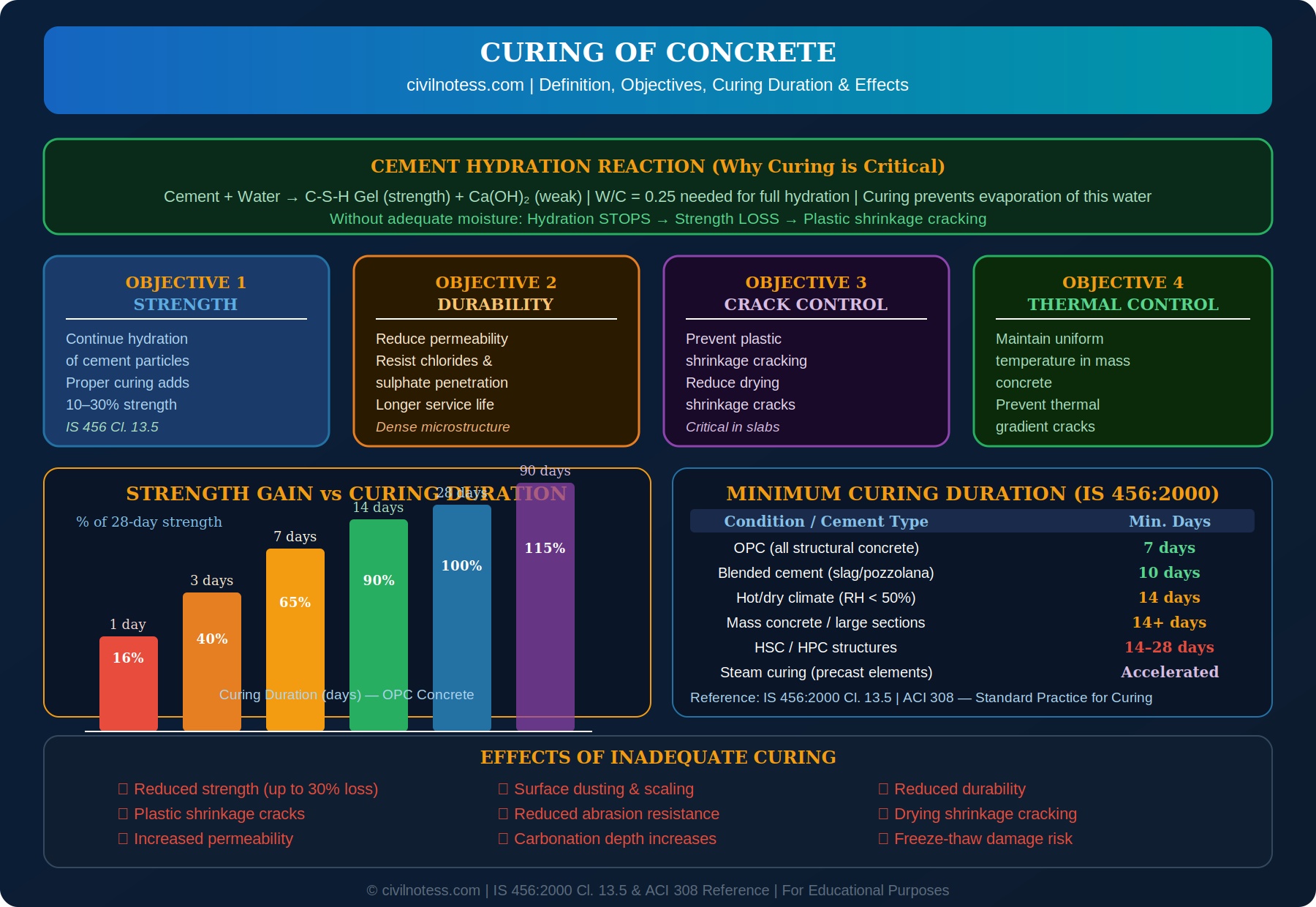
- 1. Ensure complete hydration of cement: Cement requires approximately 38% of its weight in water (W/C = 0.38) for complete chemical hydration. If the mixing water evaporates before hydration completes, strength development stops permanently.
- 2. Develop target compressive strength: Proper curing can add 10–30% to the concrete’s strength. Uncured concrete may achieve only 50–60% of its potential strength.
- 3. Improve durability and impermeability: Curing densifies the microstructure — hydration products (C-S-H gel) fill capillary pores, dramatically reducing permeability and chloride penetration.
- 4. Prevent plastic shrinkage cracking: In hot, windy, or low-humidity conditions, rapid surface drying causes plastic shrinkage cracks in fresh concrete before it has any strength. Curing by covering or misting prevents this.
- 5. Control thermal cracking in mass concrete: The heat of hydration causes temperature rise in large concrete pours. If the core-to-surface temperature gradient exceeds 20°C, thermal cracks form. Curing methods (insulation blankets, water cooling) manage this gradient.
- 6. Reduce drying shrinkage: Gradual moisture loss after curing causes long-term drying shrinkage. Proper early curing reduces the total shrinkage magnitude.
- 7. Improve abrasion and surface resistance: Well-cured concrete surface is harder, more abrasion-resistant, and less prone to surface dusting.
⚗️ Hydration Process & Why Curing Matters
When cement and water mix, a series of exothermic chemical reactions called hydration occur:
Key facts about hydration:
- Cement requires a minimum W/C ratio of 0.25 for complete chemical hydration, and W/C of 0.38 to fully hydrate all cement particles including filling gel pores.
- Hydration is a long-term, continuous process — concrete continues to gain strength for months and years if moisture is available.
- Hydration STOPS immediately when relative humidity drops below 80% in the concrete pores. This is why curing (keeping concrete moist) is so critical.
- At 20°C, approximately 70% of hydration is complete in 7 days; 90% in 28 days; nearly 100% in 90 days.
💡 The Gel-Space Ratio Concept
Powers’ gel-space ratio: Gel-space ratio = Volume of hydration products / (Volume of gel + capillary pores) = 0.657 × α / (W/C + 0.319 × α), where α = degree of hydration. As curing progresses, α increases → gel fills capillary pores → permeability drops dramatically → durability improves. This explains why extended curing dramatically improves concrete durability beyond just strength.
⏱️ Minimum Curing Duration (IS 456:2000)
| Condition / Type of Cement | Minimum Curing Duration |
|---|---|
| Ordinary Portland Cement (OPC) — all structural concrete | 7 days |
| Portland Pozzolana Cement (PPC) / Portland Slag Cement (PSC) | 10 days |
| Hot weather / Dry conditions (RH < 50% or temp > 40°C) | 14 days |
| Concrete using mineral admixtures (fly ash, silica fume) | 14 days |
| Mass concrete / Large sections (dams, raft foundations) | 14–28 days |
| High Strength / High Performance Concrete (HSC/HPC) | 14–28 days |
| Steam curing (precast elements) | Accelerated — 12–24 hours at 60–70°C |
Reference: IS 456:2000 Clause 13.5.1 | ACI 308R — Standard Practice for Curing Concrete
📈 Strength Gain of Concrete vs Curing Duration
The rate of strength gain depends heavily on cement type and curing conditions. For OPC concrete at 20°C:
| Age (Days) | % of 28-Day Strength (OPC) | % of 28-Day Strength (PPC) |
|---|---|---|
| 1 day | 16% | 8% |
| 3 days | 40% | 25% |
| 7 days | 65% | 50% |
| 14 days | 90% | 80% |
| 28 days | 100% (fck reference) | 100% |
| 90 days | 115–120% | 125–130% |
| 1 year | 125–135% | 140–150% |
⚠️ Effects of Inadequate Curing
- Strength reduction: Uncured or poorly cured concrete can lose up to 30–40% of its potential strength. A concrete designed for M25 may achieve only M15–M18.
- Plastic shrinkage cracking: Forms within hours of placing in hot/windy conditions. Cracks are wide, surface to mid-depth, and cannot be repaired effectively after formation.
- Increased permeability: Unfilled capillary pores remain open, allowing water, chlorides, CO₂ and sulphates to penetrate — leading to rebar corrosion and chemical attack.
- Reduced abrasion resistance: Under-cured floor surfaces powder and degrade quickly under traffic.
- Carbonation: CO₂ penetrates through permeable concrete and reacts with Ca(OH)₂ → CaCO₃ (carbonation). The carbonation front lowers concrete pH from ~12.5 to <9, destroying the passive oxide film on reinforcement and initiating corrosion.
- Drying shrinkage cracks: Excessive early moisture loss causes large-volume shrinkage cracks.
- Freeze-thaw damage: Poorly cured, permeable concrete in cold climates is severely damaged by freeze-thaw cycling.
❓ Exam FAQs — Curing of Concrete
Q1. What is the minimum curing period for OPC concrete as per IS 456?
7 days minimum for OPC structural concrete. For blended cement (PPC, PSC) or hot/dry weather, minimum is 10–14 days as per IS 456:2000 Clause 13.5.
Q2. Why does PPC concrete require longer curing than OPC?
PPC (Portland Pozzolana Cement) undergoes both primary hydration (cement + water) and secondary pozzolanic reaction (fly ash + Ca(OH)₂ + water → C-S-H). The pozzolanic reaction is slower and requires more time and moisture. Hence minimum 10 days curing is specified for PPC.
Q3. What is the relationship between curing and permeability of concrete?
As hydration progresses during curing, the C-S-H gel fills capillary pores, reducing capillary porosity dramatically. A fully hydrated concrete at W/C = 0.40 has nearly zero capillary porosity, while concrete with incomplete hydration (stopped by lack of moisture) retains a connected network of capillary pores through which fluids can transport.
Q4. What is the minimum relative humidity required for continued hydration?
Hydration continues only when the relative humidity inside the concrete pores is above 80%. Below this threshold, hydration stops essentially completely.
📝 Quick Summary — Curing of Concrete
- Curing = moisture + temperature + time for proper hydration
- IS 456 Cl. 13.5: OPC = 7 days | PPC/PSC = 10 days | Hot climate = 14 days
- 7-day cube should achieve ≥ 70% of 28-day fck
- Hydration stops when RH < 80% — must keep concrete moist
- Inadequate curing → up to 30–40% strength loss
- Curing improves strength, durability, impermeability, and crack resistance