📋 Table of Contents
🔷 Introduction
Corrosion of reinforcement is the most widespread and economically costly form of concrete deterioration worldwide. It is estimated that corrosion of rebars causes over 50% of all concrete repair and rehabilitation expenditure globally. It manifests as rust staining, longitudinal cracking, spalling of the concrete cover, delamination, and ultimately loss of structural capacity.
Concrete normally provides excellent protection to embedded steel through:
- Physical barrier — dense, impermeable concrete cover
- Chemical passivation — highly alkaline pore solution (pH 12–13)
Deterioration begins when either of these protection mechanisms is compromised.
🛡️ Passive Protection Provided by Concrete
In freshly hydrated, undisturbed concrete, the pore solution has a very high pH (12.5–13.5) due to the presence of Ca(OH)₂, NaOH, and KOH from cement hydration. At this pH, a thin, dense, adherent passive oxide film (γ-Fe₂O₃) forms spontaneously on the steel surface. This film is only a few nanometres thick but completely prevents further oxidation (corrosion).
💡 Why pH Matters
The passive film is stable only above pH 9.5–10. When pH drops below this threshold (due to carbonation) or when chloride ions disrupt the film locally (chloride attack), the passive protection collapses and active corrosion begins. The film does not re-form in normal atmospheric conditions once corrosion has started — the process is essentially irreversible without intervention.
⚡ Electrochemical Mechanism of Corrosion
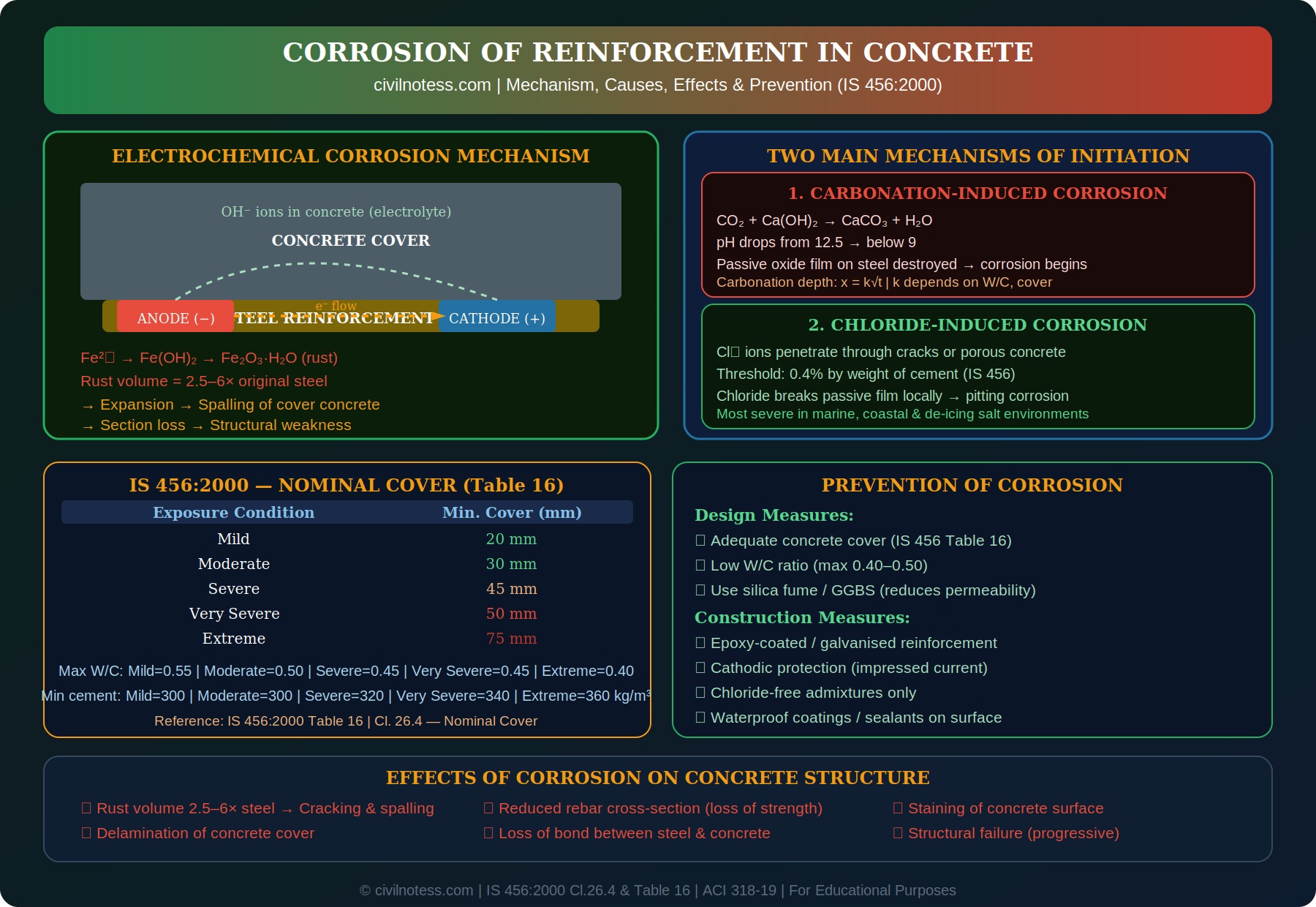
Steel corrosion in concrete is an electrochemical process exactly analogous to a galvanic cell (battery):
- Anode (oxidation): Fe → Fe²⁺ + 2e⁻ (iron dissolves — section loss)
- Cathode (reduction): O₂ + 2H₂O + 4e⁻ → 4OH⁻ (oxygen is consumed)
- Electrolyte: Pore solution in concrete (carries ions between anode and cathode)
- Rust formation: Fe²⁺ + 2OH⁻ → Fe(OH)₂ → further oxidation → Fe₂O₃·H₂O (rust)
The volumetric expansion of rust (2.5 to 6 times the original steel volume depending on the form of iron oxide produced) is the primary cause of concrete cracking, spalling, and delamination. Tensile stresses generated by this expansion easily exceed the tensile strength of concrete (~3–4 MPa).
🌫️ Carbonation-Induced Corrosion
The most common cause of corrosion in structures exposed to the atmosphere (buildings, bridges, parking garages).
- Carbonation depth progression: x = k√t (x = mm, t = years)
- Rate depends on W/C ratio, cement content, curing quality, CO₂ concentration, relative humidity
- Fastest at RH 50–70% (enough moisture for reaction, not waterlogged to block CO₂)
- Once carbonation front reaches rebar level → corrosion begins → uniform, general corrosion (whole bar corrodes)
🌊 Chloride-Induced Corrosion
More aggressive and faster than carbonation-induced corrosion. Chloride ions can disrupt the passive film even at high pH (above 12):
- Source of chlorides: seawater (3.5% NaCl), marine spray, de-icing salts (CaCl₂, NaCl), contaminated mix water/aggregates, CaCl₂ accelerators (now banned for RCC)
- Threshold chloride concentration: IS 456 specifies 0.4% by weight of cement (free chloride). ACI 318: 0.30% for reinforced, 0.08% for prestressed.
- Mechanism: Cl⁻ competitively adsorbs on the passive film, locally displacing OH⁻ and causing breakdown → pitting corrosion (deep, localised pits in the steel)
- Pitting is particularly dangerous as it rapidly penetrates the full cross-section of a bar
Silica fume, GGBS, and fly ash dramatically reduce D (chloride diffusion coefficient) — making blended cements far more effective than OPC in marine environments.
💥 Effects of Corrosion on Concrete Structures
| Effect | Description |
|---|---|
| Longitudinal cracking | Rust expansion causes cracks parallel to rebar — first visible sign |
| Spalling of cover | Concrete cover fragments and falls off — exposed rusted bar |
| Delamination | Sheets of concrete separate along the rebar plane |
| Section loss of rebar | Pitting reduces effective cross-section — reduced tensile/moment capacity |
| Bond loss | Rust destroys the bond between steel and concrete at the interface |
| Rust staining | Brown-orange stains on concrete surface — aesthetic and structural warning |
| Progressive collapse | In severe cases — structural failure if rebar section loss > 10–15% |
📐 IS 456:2000 — Nominal Cover Requirements (Cl. 26.4)
Adequate concrete cover is the primary line of defence against corrosion:
| Exposure Condition | Nominal Cover (Min.) | Max W/C | Min. Cement (kg/m³) |
|---|---|---|---|
| Mild | 20 mm | 0.55 | 300 |
| Moderate | 30 mm | 0.50 | 300 |
| Severe | 45 mm | 0.45 | 320 |
| Very Severe | 50 mm | 0.45 | 340 |
| Extreme | 75 mm | 0.40 | 360 |
Max chloride content (total) in concrete:
• Reinforced concrete: 0.4% by weight of cement
• Prestressed concrete: 0.1% by weight of cement
Max sulphate content (SO₃): 4% by weight of cement (IS 456 Cl. 8.2.4)
🛡️ Prevention and Remediation of Corrosion
Preventive Measures (New Construction):
- Adequate cover: Follow IS 456 Table 16 minimum cover strictly — use plastic cover spacers
- Low W/C ratio: 0.40–0.45 for moderate/severe exposure — reduces permeability
- Supplementary cementitious materials: 8–10% silica fume, 40–50% GGBS, or 25–35% fly ash — densify matrix, reduce chloride diffusion
- Epoxy-coated reinforcement: Fusion-bonded epoxy coating on bars — IS 13620. Effective but susceptible to damage during handling.
- Stainless steel reinforcement: For highly aggressive marine or industrial environments
- Corrosion-inhibiting admixtures: Calcium nitrite, amino alcohol based — migrate to steel surface and reinforce passive film
- Waterproofing sealers and coatings: Silane/siloxane penetrating sealers on exposed concrete surfaces
Remediation Measures (Existing Structures):
- Patch repair: Remove delaminated concrete, treat rust (wire brush + anti-corrosion primer), patch with repair mortar
- Cathodic protection: Impressed current or sacrificial anode systems — most effective long-term remediation
- Electrochemical chloride extraction (ECE): Remove chlorides from contaminated concrete using applied electric field
- Electrochemical re-alkalisation: Restore alkalinity to carbonated concrete zone near rebar
❓ Exam FAQs — Corrosion of Reinforcement
Q1. What are the two main causes of corrosion of reinforcement in concrete?
1. Carbonation-induced corrosion: CO₂ lowers pH of concrete pore solution to below 9, destroying the passive oxide film on rebar. Results in general (uniform) corrosion along the bar. 2. Chloride-induced corrosion: Cl⁻ ions penetrate through cover and disrupt the passive film locally when threshold (0.4% by wt. of cement, IS 456) is exceeded. Results in aggressive pitting corrosion.
Q2. Why is rust expansion so damaging to concrete?
Rust (iron oxides) occupies 2.5 to 6 times the volume of the original steel. This expansion generates internal tensile stresses around the rebar that exceed the tensile strength of concrete (2–4 MPa), causing longitudinal cracking parallel to the bar, followed by spalling and delamination of the cover concrete.
Q3. What is the minimum cover for reinforcement in severe exposure condition as per IS 456?
As per IS 456:2000 Table 16, the minimum nominal cover for Severe exposure condition is 45 mm. For Very Severe it is 50 mm, and for Extreme conditions it is 75 mm.
Q4. How does silica fume help prevent corrosion of reinforcement?
Silica fume (8–10% by weight of cement) reduces corrosion risk by: (a) dramatically reducing the water-to-binder ratio achievable, (b) filling capillary pores (particle size ~0.1 µm fills even nano-pores), (c) consuming Ca(OH)₂ through pozzolanic reaction — reducing leachable alkalinity but densifying C-S-H gel, and (d) reducing chloride ion diffusion coefficient by up to 90%. The net result is a much less permeable concrete that resists chloride ingress and carbonation far more effectively.
📝 Quick Summary — Corrosion of Reinforcement
- Passive film (γ-Fe₂O₃) at pH > 9.5 protects steel — must preserve this
- Mechanism: Electrochemical — Anode (Fe → Fe²⁺) + Cathode (O₂ reduced)
- Cause 1: Carbonation — Ca(OH)₂ + CO₂ → CaCO₃, pH drops → film fails
- Cause 2: Chloride — Cl⁻ disrupts passive film locally → pitting
- IS 456 Cl threshold: 0.4% (RCC), 0.1% (prestressed)
- IS 456 Table 16 cover: Mild=20 | Moderate=30 | Severe=45 | V.Severe=50 | Extreme=75 mm
- Prevention: Low W/C | adequate cover | silica fume/GGBS | epoxy-coated bars